TL;DR: DRM (Digital Rights Management) encrypts video streams to prevent unauthorized copying. The protection strength varies by security level — Widevine L1 uses hardware-isolated decryption (nearly impossible to capture), while Widevine L3 uses software-only decryption that runs in user space and can be captured at the rendering layer. Most adult creator platforms (OnlyFans, Fansly) use L3. Major streaming services (Netflix 4K, Disney+ 4K) use L1.
Digital content protection has become a foundational layer of the streaming economy. The global DRM market was valued at USD 5.53 billion in 2025 and is projected to nearly double by 2030 (Kinescope, 2026) as OTT platforms intensify content security and studios demand stricter licensing compliance. Understanding how DRM works technically — and where its enforcement boundaries lie — is essential for anyone building tools, auditing platforms, or analyzing streaming infrastructure.
This analysis covers the three dominant DRM systems, Widevine’s three-tier security architecture, the technical distinction between hardware and software decryption, and which categories of platforms fall within each protection tier.
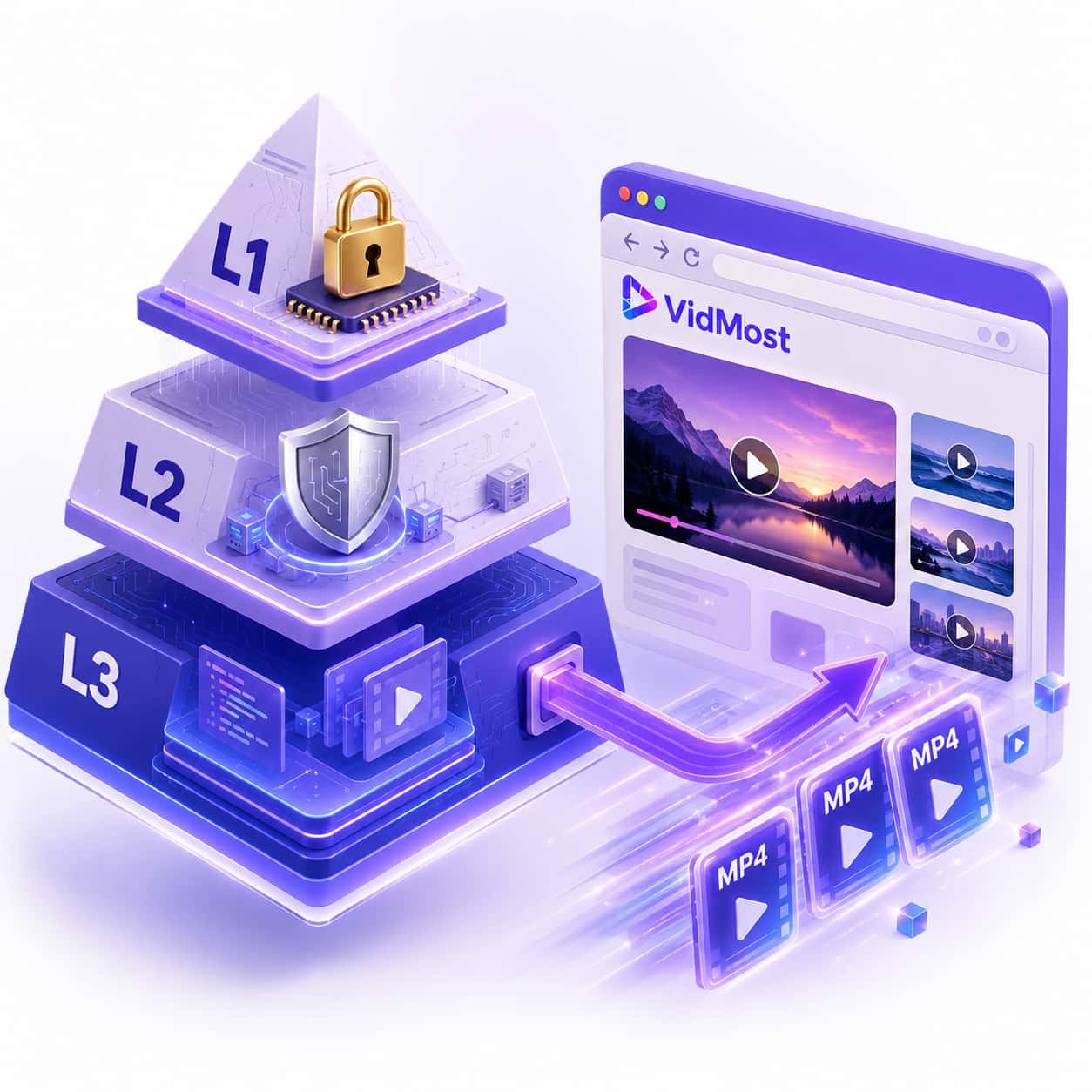
What Is DRM and How Does It Protect Video Content?
DRM (Digital Rights Management) is an encryption and license control system that prevents unauthorized copying, redistribution, and offline storage of protected media. At its core, DRM works in three stages: the content is encrypted before delivery, a license server issues a decryption key only to authenticated clients, and the decryption and playback occur inside a protected module that prevents key extraction.
The three stages map to a trust chain:
| Stage | What Happens | Where It Occurs |
|---|---|---|
| Encryption | Video is encrypted using AES-128 or AES-256 before upload | Content delivery network (CDN) |
| License issuance | Client sends authentication token; license server returns decryption key | License server (Widevine, FairPlay, PlayReady) |
| Decryption & playback | Key is used to decrypt video inside a Content Decryption Module (CDM) | Client device (browser, app, hardware) |
The security of this chain depends almost entirely on where decryption happens and whether the decrypted frames can be accessed by user-space software. This is where the L1/L2/L3 distinction becomes critical.
What Are the Three Major DRM Systems?
Three DRM systems collectively protect over 99% of commercially streamed video content globally (CastLabs, 2025). Each system is tied to a platform ecosystem and operates under a Common Encryption (CENC) standard, meaning a single encrypted content file can be decrypted by whichever DRM system the client supports.
| DRM System | Developed By | Primary Platforms | Device Coverage |
|---|---|---|---|
| Widevine | YouTube, Netflix, Disney+, Amazon Prime, HBO, Hulu, OnlyFans, Fansly | Android, Chrome, Firefox — 60%+ of global devices | |
| FairPlay | Apple | Apple TV+, iTunes, Safari-based streaming | iOS, macOS, tvOS — 25–30% of global devices |
| PlayReady | Microsoft | Xbox, Windows Media Player, many smart TVs | 4 billion+ devices (AmpVortex, 2025) |
Widevine dominates the web streaming landscape because Chrome (the world’s most-used browser) ships with Widevine’s Content Decryption Module pre-installed. This means any website using Widevine DRM works natively in Chrome without additional software — a key reason platforms like OnlyFans and Fansly default to Widevine for their paid content protection.
How Does Widevine’s L1 / L2 / L3 Security Architecture Work?
Widevine’s three security levels differ in one critical dimension: whether decryption occurs inside hardware-isolated memory (Trusted Execution Environment / TEE) or inside regular software running in user space. This distinction determines both the maximum allowed resolution and the feasibility of software-based capture.
| Security Level | Decryption Location | TEE Required | Max Resolution (Typical) | Capture Feasibility |
|---|---|---|---|---|
| L1 | Hardware TEE | Yes | 4K UHD / HDR | Extremely difficult — keys never exposed to host CPU |
| L2 | Secure co-processor | Partial | HD (1080p) | Difficult — partial hardware isolation |
| L3 | Software CDM (user space) | No | 480p–720p | Possible — decryption runs in accessible software layer |
L1 mandates that all video rendering, decryption, and key handling occur exclusively within the device’s Trusted Execution Environment (Bitmovin, 2025). The host CPU never sees the plaintext decryption keys or the unencrypted video frames. L1 is required for Netflix’s 4K tier, Disney+ 4K, and Amazon Prime Video HDR content.
L3 uses a software-only Content Decryption Module that runs entirely in user space — the same memory space accessible to applications on the host system. The decryption key and the decrypted video frames pass through software memory before reaching the display layer. This architecture is what makes software-level capture technically feasible at the L3 tier.
Desktop browsers — including Chrome, Firefox, and Edge on Windows and macOS — are limited to Widevine L3 regardless of the hardware they run on, because they cannot provide the hardware TEE attestation that L1 requires (Bunny.net Documentation).
Why Can L3 Content Be Captured While L1 Cannot?
The fundamental reason L3 content is capturable is that software-level decryption exposes plaintext video frames to user-space memory before they reach the display hardware. A tool operating at the rendering layer — below the DRM enforcement but above the display hardware — can access these frames as they pass through.
The attack surface at each level works as follows:
At L1: Decryption keys live inside the TEE. Decrypted frames are passed directly to secure display hardware via a protected media path. The host OS and all user-space applications — including screen recorders and capture tools — see only encrypted data or black frames. Capturing L1 content via software is not feasible with current consumer tools.
At L3: The software CDM decrypts video frames in regular RAM. These frames are accessible to any process with sufficient system access. Additionally, L3 decryption occurs in a Chromium-based browser’s CDM module, which runs as part of the browser process in user space. Tools built on Chromium — such as VidMost — operate within the same execution environment and can access the decrypted stream at the rendering stage.
This is not a Widevine vulnerability or a bug. It is an explicitly acknowledged limitation of software-only DRM, which is why studios cap L3 sessions at 480p–720p maximum (The Enterprise World). The lower resolution cap limits the practical damage of L3 capture while allowing the web to remain a viable delivery channel without requiring hardware certification for every browser.
Which Streaming Platforms Use Which DRM Level?
Platform DRM implementation varies significantly by content category, business model, and licensing agreement. The table below classifies major platforms by their DRM tier and practical capture feasibility using a Chromium-based tool operating at L3.
| Platform | DRM System | Security Level | Max Desktop Resolution | Capture Feasibility |
|---|---|---|---|---|
| Netflix | Widevine | L1 (4K), L3 (HD on browser) | 1080p on Chrome (L3) | Limited to 1080p on desktop browsers |
| Disney+ | Widevine + PlayReady | L1 on certified devices | 4K on L1 hardware | 1080p on browser (L3) |
| Amazon Prime Video | Widevine | L1/L3 mixed | 1080p on browser | 1080p on browser |
| YouTube Premium | Widevine | L3 on browsers | 1080p | Feasible via L3 |
| OnlyFans | Widevine | L3 | 720p | Feasible — L3 software capture |
| Fansly | Widevine | L3 | 720p | Feasible — L3 software capture |
| MYM.fans | Widevine | L3 | 720p | Feasible — L3 software capture |
| Kick | None (HLS) | N/A | 1080p+ | Feasible — open HLS, no DRM |
| Stripchat | None (HLS) | N/A | 1080p | Feasible — open HLS, no DRM |
| Chaturbate | None (HLS) | N/A | 1080p | Feasible — open HLS, no DRM |
Key insight: Creator subscription platforms (OnlyFans, Fansly, MYM.fans) deliver content via Widevine L3 because they are accessed through desktop browsers, which cannot support L1. This makes them technically in the same capture tier as YouTube — not the same tier as Netflix’s 4K library.
How Does a Chromium-Based DRM Capture Tool Work?
A Chromium-based browser like VidMost operates with the Widevine L3 CDM module pre-integrated — the same CDM that Chrome uses to decrypt protected streams. This means the browser can legitimately authenticate with Widevine license servers, receive decryption keys for L3 content, and decrypt the video stream as part of normal playback.
The capture process operates at two layers depending on whether the content uses DRM or open HLS:
For open HLS streams (Kick, Stripchat, Chaturbate, LiveJasmin):
The browser’s network layer intercepts the .m3u8 manifest and segment URLs. The tool reassembles the .ts segments into a complete MP4 without any decryption step — because there is nothing to decrypt. This is stream sniffing, not DRM bypass.
For Widevine L3 streams (OnlyFans, Fansly, MYM.fans): The browser authenticates with the Widevine license server, receives the content decryption key, decrypts the video within the software CDM, and captures the decrypted frames at the rendering layer before they reach the display. The output is saved as a standard MP4. Resolution is limited by the platform’s L3 cap — typically 720p for creator platforms.
This approach is architecturally distinct from circumventing DRM encryption (which would target the key or the encryption itself). Instead, it captures content after legitimate decryption has already occurred — at the point in the pipeline where the video is necessarily in plaintext for display.
What Are the Practical Limits of L3 Capture?
L3 capture has concrete technical limitations that users should understand before attempting to download DRM-protected content.
Resolution cap: Because platforms serving L3 sessions restrict output to 480p–720p, any captured file is limited to that resolution regardless of what resolution the platform advertises. OnlyFans videos shot in 4K are delivered to desktop browsers at 720p over L3. The capture tool receives and saves the 720p stream — there is no way to access the original 4K source through a browser-based capture.
Audio track: L3 capture captures the audio track that accompanies the video stream. For platforms using separate audio and video tracks (DASH adaptive streaming), a complete capture tool must merge both. VidMost handles this automatically as part of the MP4 assembly process.
Live vs. VOD: For live streams, capture begins from the moment recording starts — not from the stream’s beginning. For VOD content, the entire file is available for capture from the start.
L1 content is not capturable via this method: Netflix’s 4K library, Disney+ 4K, Apple TV+ 4K, and other L1-protected content requires hardware TEE access that no browser-based tool can provide. Desktop browsers are locked to L3, and L1 content is inaccessible to software-layer capture by design.
Application Cases: DRM Levels Across Creator Platforms
The following case studies illustrate how DRM implementation maps to real download scenarios across different platform types.
Case 1: OnlyFans — Widevine L3, 720p Cap
OnlyFans delivers all paid video content via Widevine L3 to desktop browsers. The platform encrypts video segments using AES-128 CENC encryption and issues Widevine license tokens tied to the authenticated user session. A Chromium-based capture tool authenticates with OnlyFans’ Widevine license server, receives the session key, and captures the decrypted video at the rendering layer.
Practical outcome: Content saves as a 720p MP4, regardless of the creator’s original upload resolution. Audio is captured as part of the stream. Free posts and paid subscription content are both accessible via L3 capture if the user has valid authentication credentials.
Case 2: Fansly — Widevine L3, 720p Cap
Fansly uses the same Widevine L3 implementation as OnlyFans. The license issuance flow and encryption scheme are architecturally identical from a capture perspective. Tier-locked content (free tier vs. paid subscription) is differentiated at the authentication layer — the capture tool captures whatever the authenticated session is licensed to see.
Case 3: Netflix — Widevine L1 (4K) + L3 (Desktop Browser)
Netflix implements a split-tier strategy: L1 on certified Android devices, smart TVs, and Windows Edge for 4K content; L3 on all desktop browsers (Chrome, Firefox) for HD. Desktop browser users are therefore limited to 1080p regardless of their subscription tier. A Chromium-based L3 capture tool can access the 1080p stream that Chrome legitimately plays — not the 4K L1 stream that requires hardware certification.
Practical outcome: Netflix 4K is not capturable via software tools. The 1080p desktop stream is within L3 range but violates Netflix’s Terms of Service and applicable copyright law under the DMCA — a separate legal consideration from technical feasibility.
Case 4: Kick / Stripchat / Chaturbate — No DRM (Open HLS)
These live streaming platforms use HLS without any DRM layer. Stream sniffing — intercepting the .m3u8 manifest at the network layer — is sufficient for capture. No license server interaction, no decryption step, no resolution cap imposed by DRM policy. The captured quality matches whatever resolution the platform delivers.
Key Takeaways for Developers and Platform Analysts
Understanding DRM tiers has direct implications for platform architecture, content security decisions, and tool development.
-
Browser-accessible content is always L3. Any platform that delivers video through a standard desktop browser (Chrome, Firefox, Edge) cannot enforce L1. If your content security strategy requires L1, you must deliver via a certified native app, not the web.
-
L3 is not “broken” DRM — it is DRM with acknowledged software-tier limitations. The resolution cap is the policy response to L3’s capture feasibility. Studios accepted this trade-off to keep web streaming viable.
-
Open HLS is entirely unprotected. Platforms using HLS without DRM (Kick, Chaturbate, most live cam sites) provide no technical barrier to capture. Any stream that plays in a browser can be downloaded.
-
Multi-DRM stacks (CENC) simplify architecture but don’t strengthen the weakest tier. A platform using Widevine + PlayReady + FairPlay is still limited to L3 for desktop Chrome delivery. CENC solves cross-platform compatibility, not security level upgrading.
-
Creator platforms are systematically L3. OnlyFans, Fansly, MYM.fans, and similar subscription platforms cannot enforce L1 because their audience accesses content via browsers. This is a structural characteristic of the browser-based creator economy, not a platform-specific security decision.
Frequently Asked Questions
What is the difference between Widevine L1 and L3?
Widevine L1 requires a hardware Trusted Execution Environment (TEE) for all decryption operations — keys and decrypted frames never enter user-accessible memory. Widevine L3 uses software-only decryption that runs in user space, where decrypted frames are accessible to processes operating at the same privilege level. L1 is used for 4K streaming on certified devices; L3 is the maximum level available in desktop browsers like Chrome and Firefox.
Can Netflix be downloaded with a Chromium-based capture tool?
Netflix’s 4K library is L1-protected and cannot be captured via software tools. Netflix’s 1080p stream delivered to desktop browsers runs at L3 and is technically within the capture range of browser-based tools — however, doing so violates the DMCA and Netflix’s Terms of Service. The technical feasibility and the legal permissibility are separate considerations.
Why is OnlyFans limited to 720p on desktop even for paying subscribers?
OnlyFans delivers content to desktop browsers via Widevine L3, which platforms typically cap at 480p–720p under DRM policy. The original uploaded file may be 4K, but the L3 delivery tier restricts what the browser receives to 720p. This is a browser-based DRM limitation, not an OnlyFans encoding decision.
What is the difference between DRM capture and stream sniffing?
Stream sniffing intercepts the URL of an unencrypted HLS stream (a .m3u8 manifest) and downloads the video segments directly — no decryption required. DRM capture involves authenticating with a license server, receiving a decryption key, decrypting the video within a CDM, and capturing the plaintext frames at the rendering layer. Open platforms like Kick use the former; creator platforms like OnlyFans require the latter.
Which DRM level does a standard desktop browser support?
All major desktop browsers — Chrome, Firefox, Edge, and Brave on Windows and macOS — are limited to Widevine L3 because they cannot provide the hardware TEE attestation that L1 requires. This is a structural platform limitation, not a browser security deficiency. L1 is available only in native applications running on certified hardware.