You know that feeling when you’re drowning in video projects? Research piling up, coffee going cold, and somewhere between the third take and the editing timeline, you wonder if adding one more platform to your plate makes any sense at all.
That’s exactly where I was when I first looked at Patreon.
Let me be straight with you: Patreon is not a magic money button. It won’t solve all your problems overnight. But after years of running my channel from a cramped basement setup, I’ve learned it can become something more important than just another revenue stream — it can become the backbone of your entire creative operation.
Here’s what Patreon actually means for someone making videos solo, and whether it’s worth your extremely limited time.
What Patreon Actually Does (Beyond the Obvious)
Most people think Patreon is just a donation box with extra steps. That’s not wrong, but it’s incomplete.
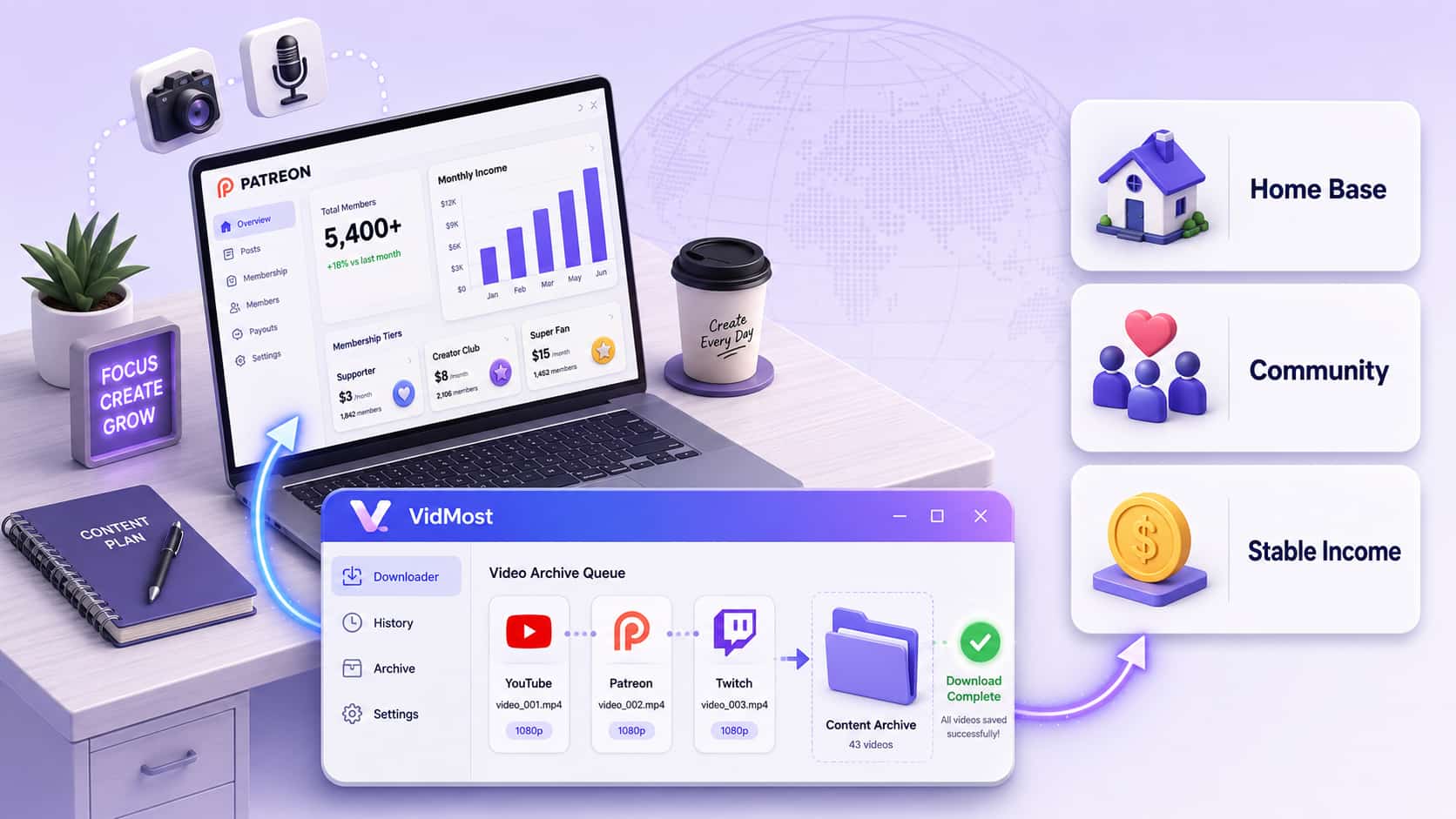
Think of it as three things rolled into one: a home base, a community hub, and a funding mechanism.
The home base part matters more than you’d expect. When you’re creating content across YouTube, social media, and maybe a newsletter, everything feels scattered. You’re shouting into different voids, hoping someone’s listening. Patreon becomes the one place where everything lives together — your sources, ad-free cuts, behind-the-scenes updates, those messy “state of the channel” videos that don’t quite fit anywhere else.
I’ve got over 5,400 newsletter subscribers through Patreon. A significant portion of that content is completely free. Why? Because having those people in one place, reachable directly without algorithm interference, gives me security. When YouTube changes how it promotes videos or social media platforms implode, those 5,400 people are still there. That’s not dramatic — that’s just the reality of building something sustainable.
The Real Reason I Started Using Patreon (It Wasn’t Money)
For years, everything happened in the basement. Not a fancy home studio — literally the basement, making videos while the dog occasionally wandered through the frame.
Money wasn’t the driving factor when I set up Patreon. I needed to find signal through noise.
The internet is an overwhelming place. You post a video and get comments ranging from thoughtful to completely unhinged. You see view counts, but those numbers don’t tell you who’s actually watching, who cares, who’d notice if you disappeared tomorrow. Patreon gave me a way to figure that out.
I remember sitting in that basement, probably spilling coffee on something important, trying to decide whether to keep using public domain images or finally pay for proper archival access. The archival service cost real money I didn’t particularly want to spend. But I thought about the people supporting me on Patreon, and I realized I owed them that quality level.
So I bit the bullet. And the videos got noticeably better — not just visually, but in the kind of stories I could tell. My supporters got better videos, and I got to make work I was actually proud of.
That’s when the relationship clicked for me. This wasn’t transactional. It was reciprocal.
How Patreon Changed My Actual Workflow
Let me get practical. The time investment is real but manageable — about an hour per week for me. That includes uploading content, writing updates, responding to comments, and occasionally dropping quick community posts.
The infrastructure matters. Video hosting, email distribution, post formatting — Patreon handles all of it. You don’t realize how much headache that saves until you’ve tried building the same thing yourself with a patchwork of different services.
What I post ranges wildly. Sometimes it’s research sources from my latest video. Other times it’s reaction videos or channel updates that feel too inside-baseball for my main YouTube audience. Some is free to anyone who follows. Some sits behind paid tiers. Both matter equally.
Free content does heavy lifting. It lets new people discover my work without commitment. Someone searching for a niche historical topic might land on a Patreon post, realize they vibe with my style, and stick around. Some become paying members. Even the ones who don’t are still part of the community, still helping spread the word.
One workflow detail most tutorials miss: managing video files across platforms. When you need to move content from one platform into your Patreon archive — or download member-exclusive content you’ve published elsewhere to reorganize — standard download tools often fail. VidMost handles this cleanly. It supports downloads from 1,000+ platforms including member-gated content and signed-in playback sessions, saves files locally at full quality, and handles batch downloads for when you’re moving larger content libraries. For cross-platform creators, this is a genuinely useful piece of the workflow.
Where the Money Actually Matters
Let’s talk funding, because you’re probably wondering about actual numbers. I’m not going to pretend Patreon made me rich. But it meaningfully changed what I could afford to do.
Better archival access. Occasionally paying for expert consultations on complex topics. Upgrading equipment gradually instead of duct-taping failing gear together for “just one more shoot.” These things add up — they’re the difference between videos that feel amateur and videos that look like they came from someone who knows what they’re doing.
More importantly, Patreon funding bought me flexibility. When a sponsor deal falls through or YouTube ad revenue dips from algorithm chaos, Patreon provides baseline stability. That means I can turn down projects that don’t fit my channel instead of taking them just to pay rent. I can spend an extra week researching when a story needs it.
For creators serious about building something long-term, that stability is worth far more than the dollar amount suggests.
The Community Part Nobody Talks About Enough
Here’s where things get less tangible but maybe more important.
The Patreon community has genuinely influenced my work. I’ve gotten video ideas from members — someone mentions a historical tangent they’re curious about, and suddenly I’m down a research rabbit hole that becomes a full episode. I’ve learned from their expertise. When you make videos about niche topics, your audience often includes actual experts in those fields who generously share their knowledge.
There’s something powerful about knowing specific people are watching. Not “50,000 views” as an abstract number, but thinking “Sarah’s probably going to love this section” or “This will answer that question Mike asked last month.” It makes the work feel less like shouting into the void and more like an ongoing conversation.
That connection is what keeps me making videos when the work gets exhausting.
When Patreon Might Not Be Worth It
Let me pump the brakes here, because Patreon isn’t right for everyone.
If you’re just starting out, Patreon is probably premature. You need some existing audience first — people who already know your work. Launching a Patreon with 50 YouTube subscribers feels awkward for everyone involved.
If you’re already stretched impossibly thin, adding Patreon might break you. That hour per week I mentioned only stays at an hour if you set clear boundaries. I’ve seen creators burn out trying to offer elaborate rewards for every tier, essentially creating multiple full-time jobs for themselves.
If your content is extremely broad or mainstream, other monetization routes might work better. Patreon shines for niche creators with devoted audiences. If you’re making general entertainment content for mass appeal, sponsorships or traditional advertising might be more straightforward.
Making Patreon Work Without Losing Your Mind
Assuming you decide to try it, here’s what I’d do differently if I started over.
Start simpler than you think you need. I launched with too many tiers and too many promised perks. You can always add more later. Begin with one or two tiers, focus on what you can sustainably deliver, and expand only when you have the bandwidth.
Make free content a priority. This feels counterintuitive, but having substantial free offerings serves multiple purposes. It lets people discover you, keeps non-paying followers engaged, and takes pressure off paid tiers to be an exclusive content machine.
Use it as your archive. Video files — especially member content and extended cuts — add up fast. Having a reliable place to store and share them matters. This is where VidMost becomes genuinely useful in practice. When you need to move your own videos between platforms or consolidate content you have permission to archive, VidMost supports signed-in browser workflows, batch downloading, 1,000+ platform support, and full quality output.
Treat your supporters like collaborators, not customers. The creators I see thriving on Patreon view their members as part of the creative process, not passive consumers paying for access. Share your struggles, ask for input, let them behind the curtain. That vulnerability builds stronger connections than any exclusive content could.
Set realistic expectations with yourself. You will not post consistently at first. You will forget to upload things. You’ll promise a behind-the-scenes video and then realize editing it takes four hours you don’t have. That’s fine. Your members are generally understanding humans who’d rather you make good main content than burn out feeding the Patreon machine.
So Is It Worth It?
Circling back: Is Patreon worth the time commitment?
For me, absolutely yes. But my situation is specific. I make niche educational content for a curious audience. I value direct relationships with viewers. I needed stability outside the whims of platform algorithms. Patreon solved all three.
Your answer might be different. If you’re making videos purely for fun with no interest in monetization or community building, Patreon is unnecessary overhead. If you’re already making sustainable income from sponsors and merchandise, it might be redundant. If you hate the idea of ongoing obligations to supporters, the model will feel suffocating.
But if you’re a solo creator trying to build something sustainable — if you want to know who’s really watching, if you’d value a home base where your most engaged audience can find everything you make — then Patreon is worth exploring seriously.
It won’t solve every problem. You’ll still spill coffee during takes. The research will still pile up. You’ll still have 3 AM moments wondering if any of this makes sense. But you might find yourself in a slightly more stable position, with a community that actually gives a damn about what you’re building.
After years of working in that basement and gradually building something bigger, that connection and stability has made all the difference. The hour per week is nothing compared to what comes back — funding that lets me make better work, impact that reminds me why I started, and knowing that when I publish that deep dive on Victorian playground equipment, there are specific people who will absolutely geek out with me.
That’s worth it to me. Whether it’s worth it to you depends on what you’re trying to build and why you’re making videos in the first place.
Frequently Asked Questions
Is Patreon worth starting with a small audience? Generally, you need some existing audience before Patreon makes sense. Most creators find Patreon starts to gain traction with at least a few hundred engaged followers who already know and value their work.
How much does Patreon take from earnings? Patreon takes 5–12% depending on your plan tier, plus standard payment processing fees. The higher your plan, the more features you access — but the percentage cut varies accordingly.
Do I need to create tons of exclusive content for paid tiers? Not necessarily. Many successful Patreon creators find that relationship and community feel retains paying members more effectively than exclusive content volume. Start with what you can consistently deliver.
How do I manage video content across Patreon and other platforms? Cross-platform content management is a real operational challenge. VidMost lets you save eligible videos from 1,000+ platforms, including your own member content and signed-in playback sessions where saving is allowed, so you can consolidate your archive locally and reupload to Patreon without rebuilding everything manually. Batch downloading makes the process manageable at scale.
What ratio of free to paid content works best on Patreon? There’s no universal formula. A rough guide: keeping 40–50% of your Patreon content free helps continuously attract new followers, while giving paid tiers enough distinct value to justify the support.
Which types of video creators do best on Patreon? Niche creators consistently outperform broad-appeal creators on Patreon. Educational content, history, documentary-style videos, technical tutorials — audiences that are small but highly engaged tend to convert and retain better than large but casual audiences.